
SPYK Dispatch — Issue 003
Jul 28, 2026
The SPYK Dispatch — Issue 003 For founders operating between $80K and $200K/month who are serious about what comes next.
I was in Shanghai last week.
& let me tell you,
Commerce there doesn't feel like an industry. It feels like weather. Live selling alone did around $900 billion last year, roughly all of US e-commerce, in one country.
Then TikTok tried to bring that format here and quit. Not a startup. ByteDance, who own Douyin, where the thing was invented, sitting on the source code. The UK pilot failed and they shelved the US and Europe.
The people who built the machine could not move the machine.
Because the format was never the machine. The machine is tens of thousands of agencies that do nothing but manufacture hosts, checkout inside the app, same day delivery, and twenty years of a country trained that this is how you shop.
None of that fit on the plane.
anyways… I drifted. you didn't open this to read about my flight lol
Okay. Straight With You.
On the 7th of July we collected $128,398 in a day.
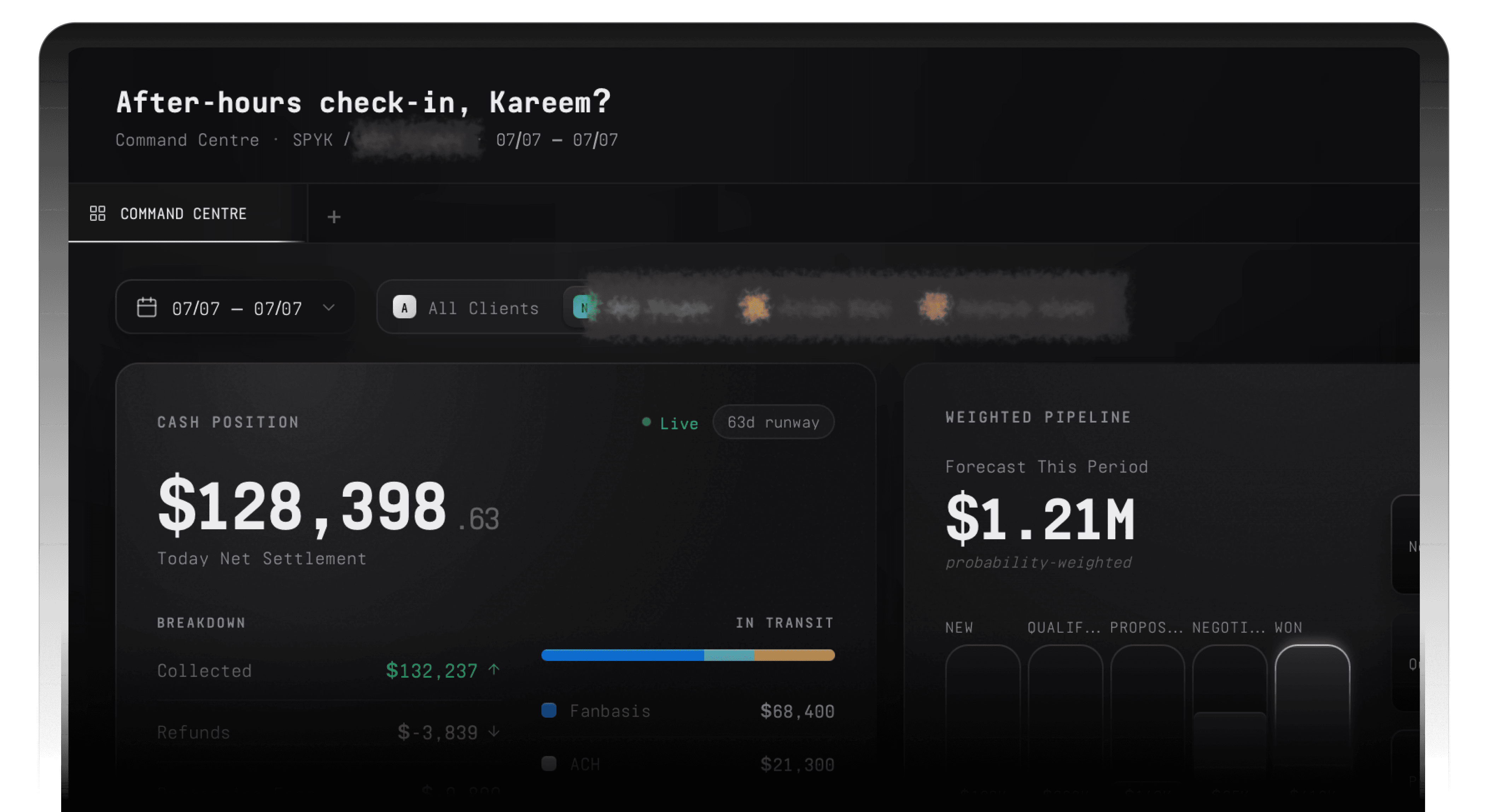
No launch. No countdown. No webinar. It was a random Tuesday. happy?
That's cash cleared, by the way. Not booked, not contracted, not "revenue."
And before you file it as a spike, don't. We're pacing $50K to $70K collected a day as the ordinary rhythm. The $128,398 is just the highest one so far, and we're building the account for $150K inside twenty four hours.
So yes. It repeats. That is the entire reason I'm telling you about it.
It also would not repeat for you, and the distance between those two sentences is what this whole dispatch is about.
Funny thing is this dispatch wasn't even supposed to be about that day.
It was built around a different one. Same account, earlier this year. $73,782 cleared against $15,602 of ad spend. ($91,734 rev. I don't count rev)
$203 a qualified booked call, 72% show rate, 28.3% close, and a branch most people don't build carrying nearly a quarter of everything paid produced.
I had the whole piece written on it. Then the 7th happened and my draft was out of date before it shipped.
(there's a lesson in there about chasing the number instead of the machine that makes it. we'll get to that one)
So now you wanna know how.
Which is the whole problem, and it's exactly why I opened with China. Because if I handed you the funnel that did it, all of it, every page, you'd be TikTok in the UK.
Let Me Say The Thing You're Expecting Me To Attack
Webinars work.
Not "worked." Work. Right now, in 2026, there are people doing $500K a month off a webinar and they are not lucky and they are not lying.
You might remember the real estate founder from the first dispatch. The one I turned down.
What I didn't tell you is what he actually wanted built.
A webinar.
$264K a month collected. Real estate education, low-ticket front end climbing into a high-ticket mentorship, cold Meta doing all the lifting. Front end self-liquidating at over 2x on day one, so it paid back double what he spent to fill it before a single backend dollar landed. CAC payback basically instant. Tracked his marginal ROAS and not his blended, which is maybe one founder in thirty at his level.
He was not a beginner. He was winning a game most operators never get into.
He'd also watched his circle put webinars up, decided that was the move, and got on the call to have me agree with him.
Meanwhile his page was converting cold traffic at 1.1%, against a band that sits at 2.5% to 4%.
So he wanted to bolt a whole new vehicle onto a machine whose door was already stuck half shut. And not just any vehicle. A second machine for doing the convincing, welded onto a front end that was already doing it well enough to pay for itself twice by lunch.
I told him no on the webinar before we ever got to whether I'd work with him.
Not because the vehicle is bad. Because of what it costs to run one, and I don't mean the ad spend.
A Funnel Doesn't Convert Anybody. It Just Decides Who Has To.
That's the whole dispatch. You can stop here if you want.
A webinar doesn't sell. A presenter sells, for forty five minutes, to a cold room, with no edit button. The webinar just decides that the presenter is the one doing it.
A VSL doesn't sell either. A script and an editor sell, asynchronously, and you get to fix them on Tuesday.
An application doesn't sell. Whatever you published for the last two years sells, and the application just collects the ones it already worked on.
Every funnel does the same total work. Get attention, make a stranger believe you, sort the buyers from the tourists, close. The vehicle is not a conversion mechanism. It's a decision about which asset in your building has to carry which part of that.
So when you copy a funnel, you are not copying a funnel.
You're copying a job description, and handing it to people who don't work for you.
Nobody Publishes What It Required. They Only Publish What It Produced
And this isn't a conspiracy. Nobody's hiding anything from you.
A result is a marketing asset. Requirements are not. Nobody posts "here is the presenter I spent eleven months finding." Nobody posts "we ran this live six times at a loss before the numbers stopped moving around." There's no screenshot of that. There's no hook in it.
So the entire industry publishes outputs, you reverse engineer inputs from outputs, and reverse engineering inputs from outputs is the exact thing that does not work.
You saw a diagram. What made it run was a bill of materials that never got attached.
Here's What A Webinar Actually Costs
Not the ad spend. The bands.
What follows is a model and I want that said before the numbers, not after. Same offer, same $10K ticket, same $5,000 into the account, run through six stages three times, changing nothing except where each stage lands. The bands are the ranges these six things live in on paid cold traffic at a $5K to $25K ticket. The arithmetic is just arithmetic.
At baseline on all six: $30 registrations, 25% show, 45% hold, 80% still there at the pitch, 7.5% book, 10% close.
That's 167 registrations, 42 people in the room, 15 still there at the pitch, one booked call, and 0.11 of a close.
Which is not a close.
$1,125 on $5,000 of spend. 0.23x.
At good: $20 registrations, 35% show, 60% hold, 88% at pitch, 15% book, 18% close.
250 registrations, 88 in the room, 6.9 booked calls, 1.25 closes.
$12,474. 2.49x.
At elite: $12 registrations, 45% show, 70% hold, 95% at pitch, 22% book, 22% close.
$60,349. 12.07x.
Read those three numbers again.
Baseline to good is not twenty percent better. It's eleven times. Baseline to elite is fifty three times, on identical spend, with the same offer, at the same price.
(if yours run differently, yours are the ones that matter. I don't have to live in your account)
Two calibrations, before you argue with me on the bands.
They assume a tight format. Forty five minutes, pitch inside the hour. At ninety minutes, take ten to fifteen points off hold. At two hours, take twenty to twenty five. Every minute of content sitting in front of the pitch is another minute somebody can leave, so the longer you run, the worse this gets, and the wider the gap between baseline and elite opens up. A long webinar doesn't give a weak presenter more time to win. It gives him more time to lose the room.
Second, that 22% close at elite is the vehicle's number, not your floor's. A properly dialled sales team runs 30% to 35% on webinar-sourced calls, sometimes better. That difference isn't the webinar. That's closers, scripts, speed to lead, and a manager who actually listens to recordings.
Which means the elite column up there is conservative. If your floor genuinely closes at a third, the spread isn't fifty three times. It's wider.
And that's this whole dispatch in one line. The vehicle decides what arrives. Somebody else entirely decides what happens to it.
Here's the part that should bother you.
Baseline is not a floor. It's a fire. There is no ticket in the $5K to $25K range where baseline performance across six stages returns your money. Not $10K. Not $25K. Baseline doesn't mean "working, needs optimization." It means nobody has shut it off yet.
A webinar has no middle. It's a printing press or it's a bonfire, and the six numbers that decide which one you get are each set by an asset you either already had or didn't.
Four Minutes. Go Pull This.
Not the webinar numbers. The one underneath everything.
Pull last month's ad spend. Pull how many people reached the point in your funnel where you say yes or no to them. Then pull how many you said no to.
If half of them got a no, your cost per qualified call is not the number on your dashboard. It's double it. You paid full retail for both of them and one of them has nowhere to go.
That's not a leak. A leak implies a hole. That's the architecture doing precisely what it was built to do, because you copied a vehicle with one exit and you inherited its one exit.
Go get the number. It's the only thing in this dispatch you can act on tonight.
The One Asset You Cannot Audit Is Yourself
Of the six stages above, three of them are a presenter.
Hold rate. Hold to pitch. Pitch to booking. Those aren't slides. That's whether a stranger who owes you nothing stays in a room for forty five minutes because of how you're talking.
Three of six. I'm not putting a percentage on it, because nobody has run the controlled test and I'm not inventing one for a newsletter. Just count the stages. Half the machine is a person.
Some of it is trainable. Pacing, transitions, where the pitch turns, handling the objection live. Eight weeks of recording yourself and hating it and doing it again.
The rest is not. Warmth through a lens. Making a hard idea feel obvious in real time. Whether conviction survives the compression of a screen. You can move that a little. You cannot manufacture it.
Now the part that isn't about skill at all.
You have audited every asset in your business. You've fired closers on data. You've killed creative you personally loved. You've cut offers that were working because they weren't working enough.
You have never once sat down and asked whether you're good on camera, because there is no dashboard for that, and the only people who could tell you honestly all report to you.
That's not ego. That's a structural blind spot with an incentive problem attached.
So the numbers come back soft and you do the rational thing. New slides. New hook. New targeting. Three optimization cycles, six weeks, twelve grand of spend, every one of them aimed at the part of the machine that was fine.
So What Is Actually Doing The Selling
If three of six stages are a presenter, ask what he's doing up there for forty five minutes.
He isn't demonstrating. He's moving a person from one position to another, and the only thing that has ever moved anybody is what gets said and whether it lands where that person is standing.
That's the message. And a message is never good or bad on its own. It's matched or it isn't.
One claim, one offer, one presenter.
Put it in front of a man who doesn't yet know he has the problem and it's noise. He isn't resisting you. He can't hear you.
Put it in front of a man who knows the problem, knows his options, and has had that same claim pitched at him by four of your competitors this quarter, and it's noise again. Different reason. He's heard it.
Same words. Two dead rooms.
And the market moves whether you're watching or not.
The message that carried you from $30K to $150K was built for people who knew less than the ones you're selling to today. Every month it runs, more of them have heard the claim, more competitors have echoed it, and identical words do less work than they did last quarter.
That is not creative fatigue. Which is why swapping the hook never fixes it.
So no. You don't need a webinar.
You need to know who you're talking to, how much they already know, how many times they've been sold this, and what you've got that hasn't been said to them yet.
The vehicle picks itself after that. It always does.
The Doctrine
The vehicle doesn't decide whether you convert. It decides what you need to own in order to.
Which means "what funnel should I run" has no answer, and never did.
It's "what car should I buy" with no mention of what you're hauling, what you're paying for fuel, or whether you can drive.
You don't pick a funnel. You take an honest inventory of what you have and what you've actually got to say, and the funnel falls out of it. Every time.
So What Did We Build Instead
Nobody picked this funnel. It got derived. And I'll show you the derivation, because that part transfers.
We started with one number. A call funnel has a single door, and roughly half of everyone who reaches it gets a no. Those people cost exactly what the yeses cost. So half the ad account was buying human beings the architecture had no way to sell.
That is not a leak you patch. That's a decision somebody made years ago that nobody has revisited since.
So we never asked what funnel to run.
Here's what we asked instead. Four questions, in order, each one handing us a piece of the build.
Who is this person before I've spent a dollar telling them anything? If the answer changes what they ought to see next, then the sorting has to happen before the pitch instead of after it. That's why there's a router at the front, and why it sorts before it captures anything.
What do I need in my hand before they leave, even if they never buy? Not an email. A phone number. Which means the capture cannot look like a form, because nobody gives a stranger their phone number to join a list. They give it up to get an answer. So the capture sits behind something they want back.
When am I allowed to tell someone no? Not at the top. A gate at the front of a funnel rejects people who would have qualified twenty minutes later, once they understood what they were looking at. So the only place we say no is after the case has been made.
And what happens to the ones I say no to? They get sold something. Not thanked and released.
That last question is worth 24.6% of paid revenue. On zero incremental spend, because those people were already bought and paid for by the time the application told them no.
Revenue, and I'll flag it, since I've already told you I don't count it. In cash it's bigger than that, because a ladder collects in full at checkout while a high ticket collects on a deposit.
Nearly a quarter of the money, out of the bin.
Four questions. Nothing exotic in any of them. You could draw the result on a napkin and I'd guess you're drawing it right now.
You still couldn't build it, and I'll tell you exactly why. The order the pieces go in. Where precisely the gate sits. And which of those two exits is allowed to report a conversion back to the platform.
Get that last one wrong and you have spent ninety days paying an algorithm to go and find you more people who don't qualify. That isn't a bug you catch. It arrives as a cost that climbs for no reason anybody can name.
Doing all of that on a live account, with a team and a calendar and revenue you can't switch off, is the part that isn't a newsletter.
One account, one architecture. I'm not dressing that up as a study.
One Last Thing
I've spent this whole dispatch doing one thing to a business you'll never meet. The $128,398 isn't the proof. The proof is that the architecture underneath it is one nobody would ever have arrived at by copying somebody.
So here's the offer, and it's the same one I gave the founder who wanted his webinar.
Tell me what you're about to build. The vehicle you've settled on, your ticket, and who's presenting.
I'll send you back the bill. What that vehicle requires, which of it you already have, which piece you're missing, and what it costs to go get.
Free. And sometimes the answer is the thing you already picked.
I'd rather hand you that before you spend the money than diagnose it after.
Your revenue archaeologist,
Kareem
Dig where they won't.
P.S. What you're actually asking me for isn't temporary. The vehicle is.
Long form text letters, squeeze pages, live selling, bridge pages, the two hour high pressure pitch. Every one of them was the answer, then wasn't. Webinar show rates across every account I've looked at have been sliding for years and nothing about that is turning around. (I'm not handing you a percentage on that one either.)
So the thing worth having was never the vehicle. It's knowing which one to build next.
P.P.S. If you read the six stages and quietly knew which one is yours, you don't need the audit. Go fix that one. You'll get more out of it than most people get out of a rebuild.
SPYK Partners — Earnings Disclaimer
The results referenced on this page and across SPYK Partners' websites, emails, ads, and content — including revenue figures, growth metrics, and client outcomes — reflect the experiences of specific clients who engaged fully with our process. They maintained their ad spend, met their content obligations, gave timely approvals, and executed consistently throughout the engagement. Their results are real. They are not typical.
Your results will depend on your offer, your market, your pricing, your sales team, your execution, and the degree to which you uphold your responsibilities within the engagement. We cannot and do not guarantee any specific revenue outcome, profit level, or business result. Nothing on this page constitutes a promise of future earnings.
SPYK Partners provides growth infrastructure, paid media, and operational systems. What you do with them determines what you earn.